
Steel wire frame or EPP frame for a seat cushion — how to choose
The question is usually asked as if the two were alternatives: steel wire frame or EPP. They are not, and starting from that assumption is what produces the expensive version of this decision. Nearly every EPP cushion or back part still has a welded steel wire frame inside or around it. The real question is narrower and more useful: how much of this part's geometry and load path should be made by bending and welding metal, and how much by a mould?
We build both sides of that answer. Wuhan Yaxin Auto Parts Co., Ltd. (武汉亚新汽车零部件有限公司) welds complete rear-seat cushion and back wire frames, and also forms and welds the wire frames that go inside EPP parts and hands them to the foam moulder. That gives us no reason to sell you one over the other, and a good reason to be precise about where the line falls. What we cannot do is mould the foam — so on the EPP side of this guide there are things we deliberately do not claim.
Not sure which side your part falls on? Send the drawing →
What each construction actually is
The welded steel wire frame
Coiled steel wire is bent to profile on a CNC wire bender, combined with laser-cut sheet-metal brackets, and welded into one rigid structure. On a rear bench that structure is the cushion pan: it carries the foam and the occupant, transfers load into the body-in-white mounting points, and is delivered to the seat maker as a finished, inspected assembly ready for foam-over on their line. Geometry comes from bend positions, bend radii and weld locations. Stiffness comes from wire diameter, section layout and how triangulated the structure is.
The engineering character of this construction: the part is the load path. Every feature exists either to carry load or to attach something. Mass is concentrated in a small volume of steel, the part is largely open, and foam is a separate item added later by somebody else.
The EPP construction
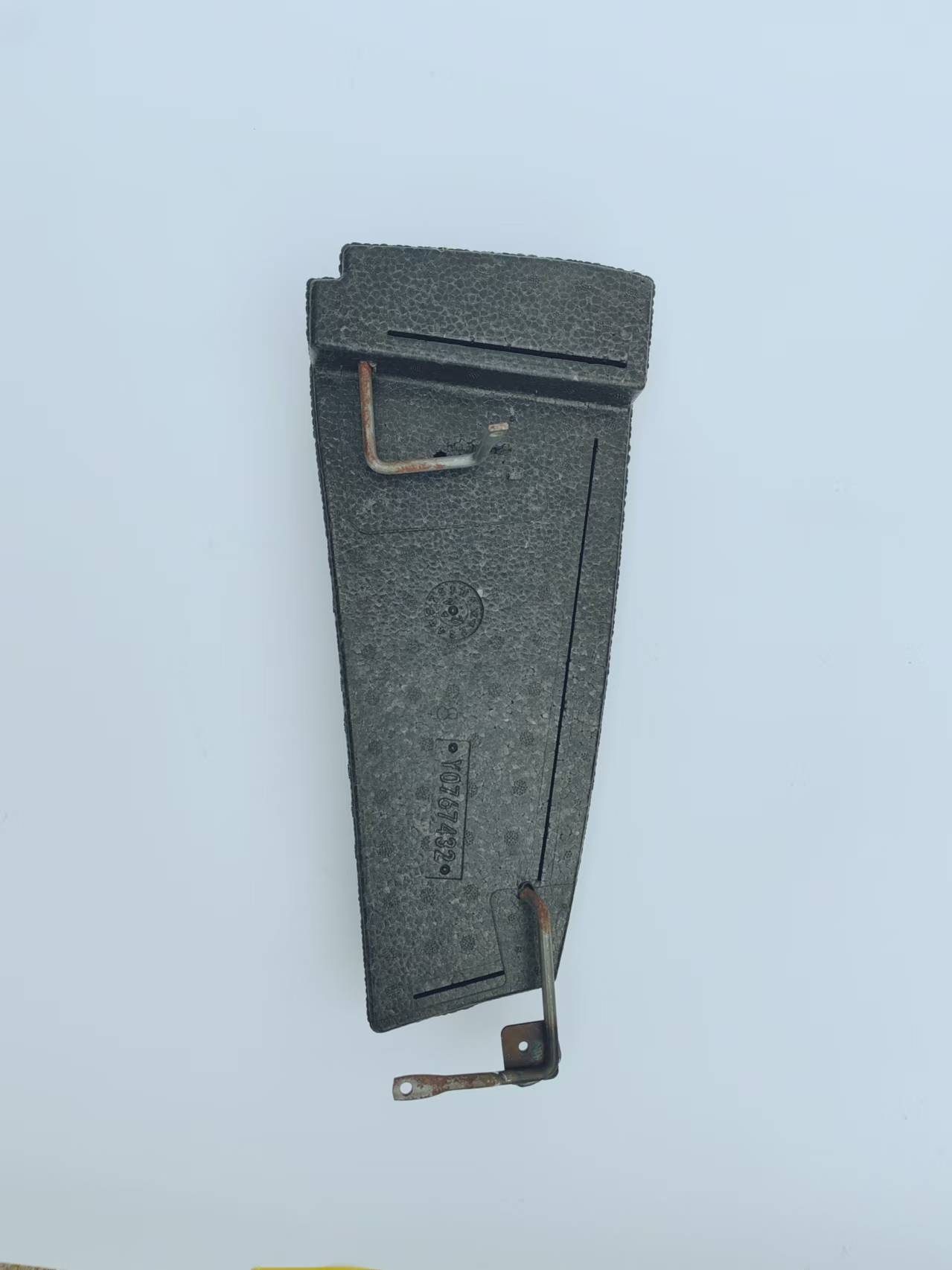
EPP — expanded polypropylene — is a light, impact-absorbing moulded foam used where a seat component has to manage energy and fill a volume rather than only carry load. In a cushion or back application the moulded EPP body does the volume and the energy management; a wire frame inside it does the two jobs the foam cannot. Our own description of that frame, unchanged from our products page because it is exactly right: it carries the foam mechanically during assembly, and it provides the fixing points to the seat structure. We form the wire profile to the mould geometry, weld in any required inserts or clips, and deliver the bare frame to the moulder, left-hand and right-hand as the programme requires.
The engineering character here is inverted: the shape is made by a cavity, not by bends. The metal retreats to the places where load is concentrated — bolt points, hinge and latch interfaces, the attachment to the seat structure — and everything in between is foam.
The eleven factors that actually decide it
Read this table as "which way does each row push", not as a scorecard. In practice two or three rows dominate any given programme and the rest follow.
| Factor | Bare welded wire frame | EPP with wire frame inside |
|---|---|---|
| Where the load path lives | In the metal, everywhere | In the metal locally, at fixing and hinge points; distributed load in the foam |
| Mass | Steel throughout the structure | Lighter for the same enclosed volume — the usual reason the question gets asked |
| Energy management | Not its job; comes from the comfort foam the seat maker adds | Intrinsic to the material, which is why EPP appears where energy targets exist |
| Tooling cost and its amortisation | Welding fixtures and gauges — quoted as a separate line, with the divisor stated | Fixtures and gauges for the frame, plus a foam mould owned by the moulder |
| Response to a late geometry change | Often a fixture and program change; bends are cheap to move | Frame change is cheap, cavity change is not; the mould sets the pace |
| Complex three-dimensional contour | Approximated bend by bend; every bend adds tolerance | Reproduced exactly and repeatably by the cavity |
| Dimensional behaviour | Tolerance accumulates across bends and welds; weld distortion is the live risk | Mould shrinkage and frame position in the cavity are the live risks |
| Number of suppliers in the chain | One, plus outsourced surface treatment | Two, and the interface between them is yours to define |
| Inspection and evidence | Dimensional on a fixture, plus weld penetration reports per part number | Same for the bare frame; the moulded part needs its own, from the moulder |
| Repair and rework | Weldable, straightenable, re-workable under the same weld specification | Crushed or torn foam is scrap; the frame inside is not recoverable separately |
| End-of-life separation | Steel, cleanly recoverable | Steel and polypropylene bonded in one body — separable, but a step, not free |
The short version
Choose the bare welded wire frame when the part is essentially a structure with fixing points and the foam is somebody else's later step: rear bench cushion pans, back frames, anything that will be welded into a larger assembly, anything on a programme whose volume cannot amortise a foam mould, and anything where you expect the geometry to move after the first samples. Bending metal is cheap to change. A cavity is not.
Choose EPP with a wire frame when mass matters, when the part has to manage energy and not just carry load, when it has to fill and locate against a three-dimensional contour that would need an unreasonable number of bends to approximate, and when volume will repay a mould. And accept the consequence: you now have two suppliers and one interface, and the interface is the part that needs your attention.
The tolerance and datum argument, which is where these programmes go wrong
On a bare wire frame the tolerance story is self-contained. The part is measured on a checking fixture against the datums on your drawing, deviation accumulates across bends and is redistributed by weld shrinkage, and the arguments are the usual ones — bend position, free state versus restrained measurement, which features are fixture-restrained during inspection. One supplier, one drawing, one gauge.
Moulding a frame into EPP splits that story across a boundary, and the boundary is not always drawn. Here is the failure mode, stated plainly because we have seen the discussion land at the frame supplier's door more than once: the drawing dimensions a fixing point on the finished moulded part; the frame is made to a frame drawing that nobody has checked for whether the finished dimension is achievable from it; the moulded part misses; and two suppliers each demonstrate, correctly, that they made what they were asked to make.
What prevents it is dull and cheap:
- Dimension the bare frame on the frame drawing, with its own datums and its own inspection method, and dimension the moulded part on the moulded part drawing. Two drawings, not one drawing used twice.
- State which datums transfer across the moulding step and which do not. A datum defined on a feature that the cavity grips is not the same datum after moulding.
- Agree how the frame is located in the cavity, and who owns that locating scheme. This is the single most consequential sentence in an EPP frame programme and it is usually missing.
- Decide where inserts are welded: on the bare frame before moulding, or fitted after. Welded before is generally cleaner and is what we do — clips, nuts and inserts welded in before foam-over — but it means the weld has to survive the moulding cycle and be inspectable through it.
- Say who measures the finished part and against what. If the answer is "the moulder", say so in writing, because otherwise the first dimensional dispute begins with an argument about who should have been measuring.
What a drawing needs to carry, for each
Sending a drawing is the fastest way to get a real answer out of us. These are the fields that decide whether we can quote it or have to come back with questions.
For a welded wire frame
- Geometry as PDF, STEP, DWG or DXF — STEP preferred for anything with real three-dimensional bends.
- Wire and tube material specification and diameter. Our forming window covers φ2–φ14 mm wire and φ8–φ52 mm tube; outside it, tell us and we will say so rather than quote and discover later.
- Datum scheme and the GD&T that follows from it, plus which features are inspected restrained.
- Weld locations, weld specification and acceptance criteria — see our guide on reading a weld penetration report for what those criteria have to say to be measurable.
- Surface treatment requirement. E-coat and zinc plating are placed with qualified outside processors and passed through at the processor's rate as their own quotation line; we state this up front rather than implying we plate in-house.
- Annual volume and start-of-production date. Volume is the divisor in the tooling amortisation line, so without it the piece price is undefined rather than merely uncertain.
For a wire frame that will be moulded into EPP
Everything above, and four more:
- The mould geometry or the moulded part model, so we can see what the frame has to follow. We form the wire profile to the mould cavities, so the cavity is an input to our process.
- The locating scheme for the frame in the cavity, or a statement that it is still open — either is workable, silence is not.
- Inserts, clips and nuts: type, position, and whether they are welded before foam-over.
- Left-hand and right-hand handing, and whether both are on the same tooling or separate.
What this costs, and why our quotation has three lines
The construction choice changes the shape of the cost, not just its size, and a single-number quotation hides exactly the part you need to see. Ours is always three separate lines: part processing cost; tooling amortisation with the divisor stated; and outsourced surface treatment at the processor's rate.
Read against this decision, those lines say something specific. A bare wire frame usually carries more in line one — there is more metal being bent and welded — and a fixture-and-gauge figure in line two that you can recalculate at a different volume because the divisor is printed on the line. An EPP frame usually carries less in line one, because the frame is smaller and simpler than a full structure, but the programme as a whole carries a foam mould that is not in our quotation at all, because it is not ours. When you compare the two constructions, compare complete programmes. Comparing our EPP frame price against our full frame price and concluding EPP is cheaper is a real mistake and an easy one, and no honest quotation format can prevent it — only reading it as one of two lines can.
What we will not tell you
Three limits, stated because a comparison guide written by a supplier is worth nothing without them:
- We do not mould EPP. We deliver the bare frame to the foam moulder. We cannot quote the foam, cannot commit to the moulder's lead time, and cannot validate the energy absorption of the finished part. Anyone selling you a comparison who is also selling you both halves has an incentive we do not have — and a conflict we do not have either.
- We do not hold design authority. Our certification is IATF 16949:2016, scope manufacture of seat frame assemblies, with design responsibility excluded. The construction decision is yours. What we can do is tell you what each option costs us to make and what will be hard to hold, before you commit — see what "design excluded" means.
- We do not build the front-seat structure. A front-seat frame is predominantly stamped sheet-metal panels and large stamping is not a process we run. On a front seat we supply the wire and tube parts that mount on that structure — not the structure. If your EPP or wire part is a front-seat panel, we are the wrong supplier and you should know that from this page rather than from week three of a quotation.
Questions we get about this choice
Is an EPP frame a replacement for a steel wire frame?
Usually not, and this is the most common misreading of the choice. Nearly every EPP cushion or back part still has a welded steel wire frame inside or around it, because the moulded foam carries distributed load well but cannot provide hard fixing points to the seat structure or resist concentrated loads at a bolt. What changes between the two constructions is where the load path lives and how much of the geometry is made by bending metal rather than by a mould. It is a question of division of work, not of one material replacing the other.
When is a bare welded wire frame the better answer?
When the geometry is essentially a structure rather than a shape: a rear bench cushion pan, a back frame, anything where the part is a load path with fixing points and the foam is added separately by the seat maker. A bare wire frame also wins when the programme cannot pay for a foam mould, when annual volume is low enough that tooling amortisation dominates the piece price, when late geometry changes are likely, and when the part has to be welded into a larger assembly afterwards. Bending metal is cheap to change; a foam cavity is not.
When does an EPP construction win?
When mass matters, when the part has to manage energy rather than only carry load, and when the shape is a three-dimensional volume that would take an unreasonable number of bends and welds to approximate in wire. EPP also wins where the part has to fill a space and locate against a contour, because a mould reproduces a contour exactly and repeatably while a welded wire approximation of the same contour accumulates tolerance at every bend and joint.
Who owns the tolerance when a wire frame is moulded into EPP?
It has to be split explicitly in the drawing, and this is where these programmes most often go wrong. The frame supplier owns the frame as delivered, measured on its own fixture against its own datums. The moulder owns the moulded part, including how the frame sits in the cavity and how the foam shrinks around it. The failure mode is a drawing that dimensions a fixing point on the finished moulded part while nobody has agreed what the bare frame must measure for that dimension to be achievable. Dimension the frame on the frame drawing, dimension the moulded part on the moulded part drawing, and state which datums transfer.
What do you build, and what do you not build?
We build wire and tube welded structures: complete rear-seat cushion and back frames, cushion support tubes, adjuster links and brackets, and the wire frames that go inside EPP parts, formed to the mould geometry with clips, nuts and inserts welded in before foam-over and supplied left-hand and right-hand as the programme requires. We do not mould EPP and we do not make the front-seat structure itself, which is predominantly stamped sheet metal. On an EPP programme we deliver the bare frame to the foam moulder, which means we cannot quote the foam and cannot validate energy absorption of the finished part.
How quickly can we see a sample of each?
A wire-formed sample takes 3 working days from a released drawing. A welded assembly, seat frame or tube part sample takes 10 working days, because that includes building the welding fixture needed to produce a representative one. For an EPP frame the frame itself follows the welded-assembly lead time, while the finished moulded part depends on the moulder's tooling, not on us. We also print check fixtures and jigs in-house in 3D, so your validation loop is not waiting on hard tooling.
Send the drawing before the decision is final
The useful moment to involve a frame supplier is while both constructions are still on the table, because that is when what we know is worth something to you. Send the geometry as PDF, STEP, DWG or DXF with your annual volume and start-of-production date, and say which construction you are leaning towards. Within 3 working days you get back a three-line quotation for the part as drawn, or the specific list of what we still need — and if we think the other construction is the cheaper way to get what you are after, we will say so in the same reply. We do not hold design authority over your part, which means we also have nothing to defend.