IATF 16949 "design excluded" — what it means for the part you are sourcing
You are looking at a supplier's IATF 16949 certificate and it says design excluded, or excluding product design, or manufacture of … , design responsibility excluded. Short answer: it means that supplier does not carry product design responsibility inside its certified quality management system. It manufactures to your drawing. It does not mean the certificate is weaker, partial, or suspect: the standard explicitly permits this exclusion, and it is the ordinary certification shape for a supplier that manufactures to a customer's drawing rather than to its own. What it does mean is that the design of the part stays your responsibility, and that you should read three other lines on that certificate — the scope, the site, and the validity dates — before you decide the certificate covers the part you are about to source.
We are one of those design-excluded suppliers. Wuhan Yaxin Auto Parts Co., Ltd. (武汉亚新汽车零部件有限公司) is certified to IATF 16949:2016, scope manufacture of seat frame assemblies, design excluded. Rather than explain the clause in the abstract, this guide walks through our own certificate field by field, tells you how to check each field against a source that is not us, and is honest about what the exclusion means for how you have to work with us.
Skip the theory and send us a drawing →
What does "design excluded" actually exclude?
It excludes one clause: product design and development. In ISO 9001:2015, on which IATF 16949:2016 is built, that is clause 8.3. A supplier that neither designs the product nor has design authority over it may take a documented exclusion for that clause, state the justification, and be certified for everything else.
Two things it does not exclude, and this is where buyers most often misread a certificate:
- Manufacturing process design is never excludable. Even with product design excluded, the supplier remains fully responsible under the standard for designing the process that makes the part: the process flow, the PFMEA, the control plan, the fixtures, the weld schedules, the gauges, the reaction plan when something goes out of control. If a supplier tells you "design is excluded, so the process is your problem," the certificate does not support that claim.
- It does not exclude the supplier from your requirements. Customer-specific requirements, PPAP, change control, traceability, the lot — all of that still applies. The exclusion is narrow and it is about who owns the product definition, not about how much quality system you get.
In practice the line falls like this on a welded seat frame: you own the geometry, the material specification, the GD&T, the functional and crash requirements, and the decision that this bracket goes here. We own how that geometry is reliably produced ten thousand times — which bender, which fixture, which weld sequence, what current, how it is measured, and what we do on the day a weld drifts.
Why does the standard allow the exclusion at all?
Because forcing a component manufacturer to claim design responsibility it does not have would make the certificate less truthful, not more. The seat maker or the OEM designs the seat. Dozens of suppliers manufacture to that design. The certification scheme reflects the real division of work. A certificate that quietly claimed design capability the supplier does not exercise would be the actual red flag.
How do I read our certificate, field by field?
Here are the fields that decide whether a certificate means anything for your part, in the order they matter to you. The identifying numbers on it — certificate number, IATF registration, site identifier — are not published on the open web; they are on the certificate itself, and we send the Chinese and English originals with our quotation. Every value below is on our certificate and is on our home page; nothing here is rounded, illustrative, or "typical".
| Field | Our value | What you should do with it |
|---|---|---|
| Standard and edition | IATF 16949:2016 | Confirm the edition, not just the number |
| Scope | Manufacture of seat frame assemblies | The most load-bearing line on the page. See below |
| Design responsibility | Excluded | Means we build to your drawing and do not carry product design responsibility |
| Valid from / valid to | 2026-05-28 → 2029-05-28 | A certificate outside its dates certifies nothing |
| Site address | Building 2, Chenxin Industrial Park, No. 568 Xingcheng Avenue, Hannan District, Wuhan, Hubei 430090, China | Must match the plant that will make your part |
| Legal entity | Wuhan Yaxin Auto Parts Co., Ltd. / 武汉亚新汽车零部件有限公司, unified social credit code 914201137310518213 | Must match the entity that will sign your contract and invoice you |
| Issued languages | Chinese and English originals | Ask for both; we send them with the quotation |
What is the USI, and why does it matter more than it looks?
The IATF Unique Site Identifier is a six-character alphanumeric code that the IATF introduced into the certification scheme on 2 October 2022. Its purpose is to give every physical location in an IATF 16949 certification a permanent identifier tied to that address and its coordinates, kept for as long as the site stays where it is.
That permanence is exactly what makes it useful to a sourcing engineer. Company names change, certification bodies change, certificate numbers are reissued at recertification. The USI does not move, because the building does not move. If a supplier gives you a certificate whose site address is not the address you were shown on the factory audit, the USI is the field that makes the mismatch legible rather than arguable.
How do I verify a Chinese supplier's IATF 16949 certificate is real?
Do not verify it from the PDF the supplier sent you. A PDF proves that a PDF exists. Do this instead, in this order:
- Check validity in the IATF Customer Portal. The IATF operates a customer portal where any interested party can check an IATF 16949 certificate using the certificate number; it returns the current status and the name of the certified client. Status matters as much as existence: a certificate can be valid, suspended, or withdrawn, and only the portal will tell you which. Note that IATF 16949 certificates are not carried in the general IAF CertSearch database — use the IATF's own portal.
- Match the site, not just the company. Certification under IATF 16949 is site-specific. A group can hold a certificate for one plant while your parts are produced at a second, uncertified plant, or subcontracted out entirely. Compare the address and USI on the certificate against the address on your purchase order and the address you audited.
- Read the scope sentence literally. See the next section.
- Check the dates against your SOP date, not against today. A certificate that expires eight months into your programme is a topic for the sourcing conversation now, not a surprise later.
- Ask which processes are outsourced. A certificate covers the certified organisation's own processes. Any step placed with an outside processor is controlled by the certified supplier as an external provider — it is not the same thing as that step being inside the certified scope. Ask for the list. (Ours is one line, and it is in this guide.)
- Ask for both language originals. We issue Chinese and English originals; a supplier that can only produce a screenshot is telling you something.
Why is the scope line more important than the certificate itself?
Because the certificate certifies the scope, not the company. "IATF 16949 certified" with no scope attached is close to meaningless for your decision.
Our scope reads manufacture of seat frame assemblies. If you are sourcing a welded seat cushion wire frame, a seat back frame, a bent tube sub-assembly or a laser-cut bracket that goes into one — that sentence covers what you are buying. If you were sourcing an airbag inflator from us, the same certificate would be irrelevant to you even though it is genuine and valid.
So the test is not "does this supplier have IATF 16949?" It is: does the scope sentence on this certificate describe the part in my drawing, at the site that will make it, on the date it will be made? Four conditions, one question. Most sourcing surprises are one of those four quietly failing.
What does "design excluded" change about working with us?
It changes who has to be precise about what, and it is worth being explicit because the boundary is where programmes go wrong.
You bring, and own: the drawing (PDF, STEP, DWG or DXF), the material specification, GD&T and datum scheme, functional and durability requirements, the annual volume, and the SOP date. If the drawing is ambiguous, we cannot resolve the ambiguity by design authority we do not have — we have to ask you.
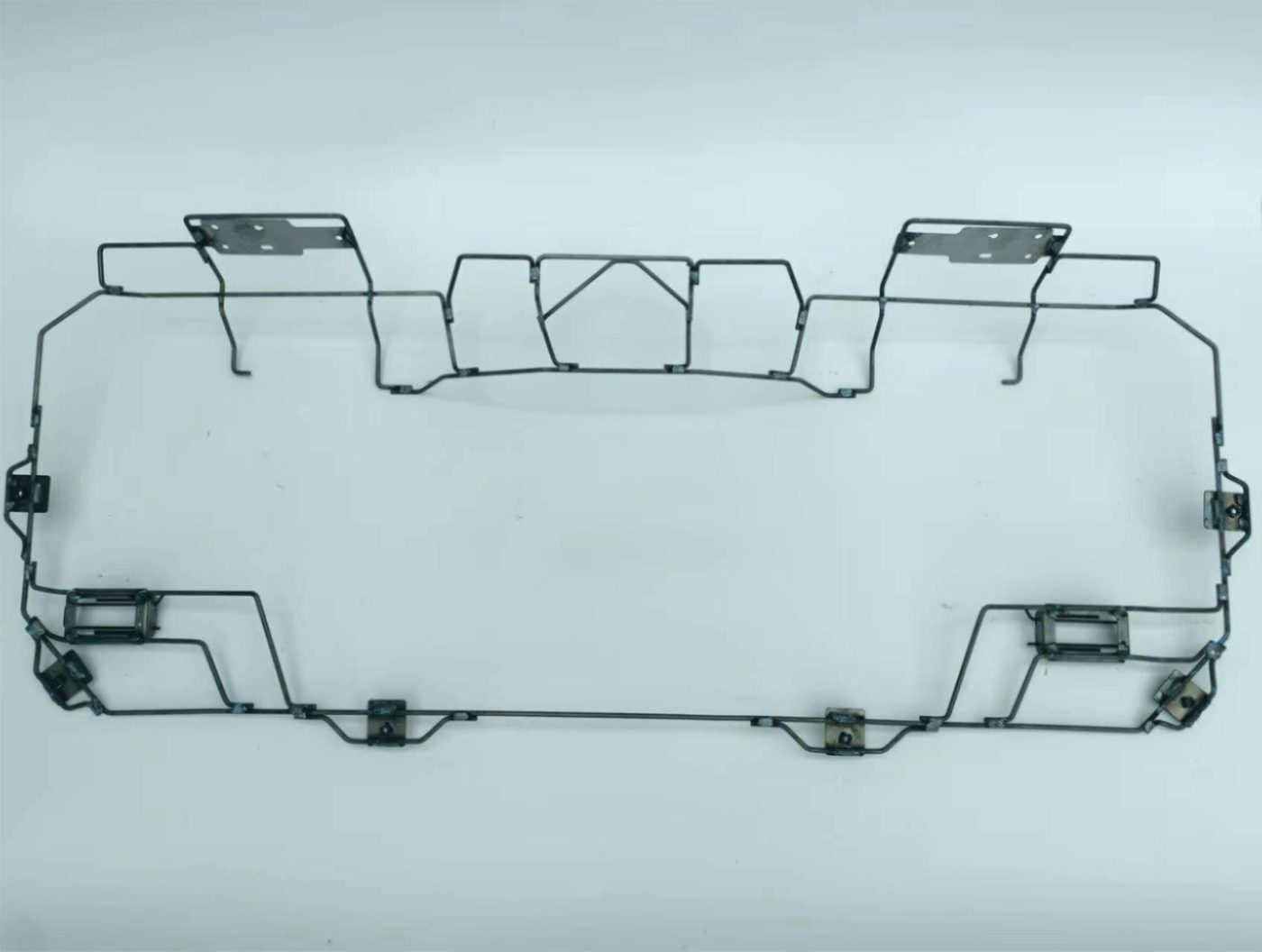
We bring, and own: everything about producing it. Wire and tube bending, laser cutting of the sheet-metal brackets, piercing and flattening, robotic MIG and spot welding on 7 welding robots, fixture and gauge design, the weld schedules, and inspection. That is manufacturing process design, it is not excluded from our certificate, and it is ours.
Where the boundary gets useful rather than bureaucratic: when we read your drawing and see something that will be expensive or unstable to weld — a joint the robot torch cannot reach at that angle, a tolerance stack that a welded assembly will not hold, a bracket that wants two fixtures where one would do — we tell you, with the reason, and we tell you before quoting rather than after. We cannot change your design. We can tell you what it costs us and hand the decision back to you with the information attached. Design excluded does not mean opinion excluded.
Does a design-excluded supplier still owe you PPAP and change control?
Yes, and this is the single most common thing buyers assume the exclusion touches. It does not.
The exclusion removes product design and development from the certified system. It removes nothing from the production part approval and change disciplines that sit downstream of a design someone else owns. Concretely, a design-excluded supplier is still on the hook for the process flow diagram, the process FMEA, the control plan, measurement systems analysis on the gauges it uses to accept your part, initial process capability studies, and the submission package that demonstrates all of it against your drawing at the agreed volume. Customer-specific requirements still apply in full — and for a design-excluded supplier they often apply harder, because everything the supplier submits is measured against a drawing it cannot change.
Change control is the sharper edge. Because we do not hold design authority, we cannot make a product change, and we do not get to decide that a change is minor. If we want to move a weld, change a fixture in a way that alters the process, requalify a material source or shift a step to a different line, that is a change to the approved process and it comes back to you for approval before it happens, not in a monthly report afterwards. The exclusion makes that boundary cleaner than it would be with a design-responsible supplier, not vaguer: there is exactly one party that can approve a product change, and it is not us.
What that means practically when you send a drawing: tell us the submission level you expect and the customer-specific requirements that apply, and tell us at RFQ stage rather than at PPAP stage. The requirements are not the expensive part. Discovering them late is.
Who is responsible when a part fails?
Split it the same way. If the part was built to the drawing and the drawing is wrong for the application, that is a product design issue and it sits with whoever holds design authority. If the part deviates from the drawing, that is ours, and the way we make that answerable is by measuring the things that cannot be seen.
Welding is a special process: you cannot see a bad weld from the outside. So our quality department issues weld penetration reports from sectioned and etched samples, part number by part number, and they are available on request for the parts we quote you. Assemblies with threaded or bolted interfaces are additionally checked on a torque test rig. That is what turns "we build to your drawing" from a disclaimer into something you can audit.
What should you ask a design-excluded supplier for, alongside the certificate?
A checklist you can paste into your own supplier questionnaire. These are the things the certificate does not tell you and the quotation should.
- Both language originals of the certificate, not a screenshot.
- The outsourced-process list. Ours: surface treatment — e-coat and zinc plating — placed with qualified outside processors. Everything else in the chain is on our own floor. We say so before you ask, because the alternative is a buyer discovering it during a process audit.
- Evidence for the special processes. For welding, that is weld penetration reports from sectioned samples, per part number.
- A quotation that is itemised, not a lump sum. Ours is always three separate lines: (1) part processing cost — material, bending, laser cutting and welding labour; (2) tooling amortisation — fixture and gauge cost divided by the volume you commit to, with the divisor stated on the line so you can recalculate it at a different volume; (3) outsourced surface treatment at the processor's rate. Each line can be challenged on its own. A single number cannot be.
- Who you will actually talk to, and how fast. Our overseas business desk replies within 3 working days of receiving a drawing — either with a quotation, or with the specific list of questions we need answered before we can make one.
Three red flags a valid certificate will not protect you from
- A trading company presenting a factory's certificate. The legal entity on the certificate is the entity that was audited. If the company that will invoice you is not the company on the certificate, you are not buying from the certified organisation. Our certificate, our plant and our invoicing entity are one entity: Wuhan Yaxin Auto Parts Co., Ltd., unified social credit code 914201137310518213.
- Scope creep in the sales conversation. "We are IATF certified" said about a process that is outside the scope sentence, or performed at a different site, is a claim the certificate does not support.
- Outsourced steps described as in-house. This is the most common one and the easiest to check: ask which steps leave the building, and compare the answer to the process chain the supplier published.
What would we actually send you?
Concretely, for a part in our families, the reply to a drawing contains:
- the three-line quotation described above, with the tooling divisor stated;
- our IATF 16949:2016 certificate, Chinese and English originals, so you can run the verification steps in this guide yourself;
- confirmation of which steps are in-house and which one is outsourced;
- and, on request, the weld penetration report format we would issue against your part number.
Questions about our certificate
Does "design excluded" mean the certificate is only partial?
No. Design exclusion is a documented, permitted exclusion of the product design and development clause for suppliers that do not hold design authority over the product. Everything else in IATF 16949:2016 still applies, including manufacturing process design, which is never excludable. Our certificate is a full IATF 16949:2016 certificate with design responsibility excluded.
What scope is Wuhan Yaxin's IATF 16949 certificate issued for?
The certified scope is manufacture of seat frame assemblies, with design responsibility excluded, under IATF 16949:2016. That covers welded seat cushion wire frames, seat back frames, bent tube sub-assemblies and the laser-cut brackets that go into them. Certification is site-specific, so read the scope line together with the site address on the certificate. We do not publish certificate identifiers on this site: Chinese and English originals are issued and are sent with our quotation, and you can check current status yourself in the IATF Customer Portal from the certificate.
How can I verify an IATF 16949 certificate independently?
Check the certificate number in the IATF Customer Portal, which returns the current status of the certificate and the name of the certified client. IATF 16949 certificates are not listed in the general IAF CertSearch database, so use the IATF's own portal. Then confirm that the site address and Unique Site Identifier on the certificate match the plant that will actually make your part, because certification under IATF 16949 is site-specific.
If you do not design the part, who is responsible if it fails?
Product design responsibility stays with whoever holds design authority — normally the seat maker or the OEM. Manufacturing conformity is ours: if the part deviates from your drawing, that is our responsibility. Because welding is a special process that cannot be judged from the outside, our quality department issues weld penetration reports from sectioned and etched samples, part number by part number, available on request for the parts we quote you.
Which processes do you outsource?
Surface treatment — e-coat and zinc plating — is the one step we place with qualified outside processors, passed through at the processor's rate as its own quotation line. Wire and tube bending, laser cutting, piercing and flattening, robotic MIG and spot welding on 7 welding robots, and final inspection all happen on our own floor.
Send the drawing
If the scope sentence on our certificate matches the part in your drawing, the next step is small: send the drawing as PDF, STEP, DWG or DXF, with your annual volume and your SOP date. Within 3 working days you get back either a three-line quotation or the precise list of what we still need to know. Both of those are more useful than another certificate PDF.