
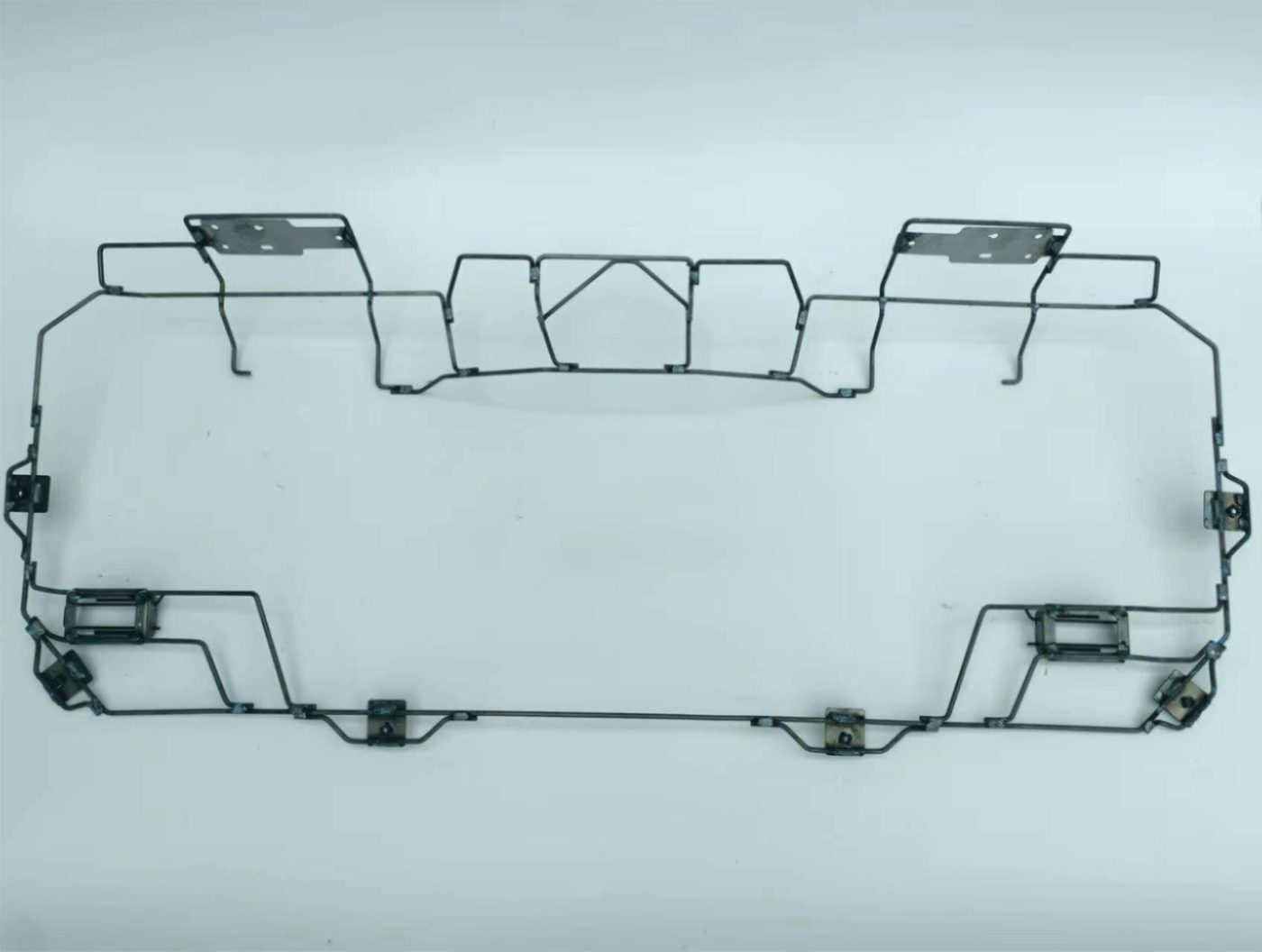
Wire inserts for foam-in-place seat cushions
If you are sourcing a foamed seat cushion, you are buying two things from two places. You place the pad with a foam supplier, and you place the steel wire insert that goes into their tool with somebody else. We are the somebody else.
Wuhan Yaxin Auto Parts Co., Ltd. (武汉亚新汽车零部件有限公司) bends and welds the wire and tube structures that sit inside foamed seat cushions and backs — the insert the foam closes around, with its clips, nuts and brackets already welded on, supplied left-hand and right-hand as the programme needs. We have been doing it since 2001 for seat makers in China, and it is our core product rather than a sideline: seat cushion foam wire frames are what the plant is built around.
We do not foam. We have no mould, no chemical system, no intention of acquiring either. So there is no version of this where we try to take the pad off you as well — you keep the foam sourcing where you put it, and this page is only about the metal.
How the part moves: you buy it, your moulder receives it
The normal arrangement is that you contract us for the insert and contract the foam supplier for the pad, and the insert is delivered to the moulder's plant to be consumed there. The part ships to an address that is not yours. That has four practical consequences, and we would rather write them down than discover them on the first shipment:
We supply to your drawing, not to theirs. Your engineering owns the insert geometry, the datum scheme and the acceptance criteria, and we take changes only from you. If the moulder's process engineer wants a feature moved because it fouls a nest, that is a good conversation to have — but it comes back through you as a drawing revision, not as a phone call that quietly changes what we build.
Packing is designed for their loading station, not for our dock. Inserts are handled by an operator with a few seconds per cycle, so how they are nested, protected and presented decides whether the moulder can actually run them. Tell us how the parts are taken out of the box at the tool and we will design the packing around that. Ask us to guess and we will pack for shipping, which is the wrong optimisation.
Labelling has to work for a third party. The person who opens the box has your programme in their system and possibly nothing of ours. Give us the label content and layout your moulder expects — part identification, revision, quantity, date, LH/RH — and we print what you specify.
A reject is found at a plant neither of us is standing in. So the escalation path belongs in the agreement, not in goodwill: who is notified, what evidence travels back to us, how a sorted lot is handled, what containment looks like when parts are already staged at the tool. We would rather agree that on a blank sheet before the first shipment than negotiate it during a line stop.
What the insert has to survive, and what that changes
A foam-in-place cushion insert is not judged the way a bare frame is judged. A bare frame is measured, boxed, and bolted into a seat. An insert is measured, then handed to an operator who has a few seconds to drop it into a hot tool, and then it disappears inside a part nobody can re-open. Four consequences follow, and they are the four things we ask about before quoting:
It has to go in one way and stay there. An insert that can be loaded rotated, or that sits proud of its nests, produces a pad that fails at final inspection — after the foam supplier's cycle, chemistry and labour have been spent on it, and after you have paid for a pad you cannot sell. So the free-state shape matters more than the restrained shape. Tell us where the tool's locating nests grip, and we will hold form on those features and let the tolerance fall elsewhere, rather than spreading it evenly and hoping.
It has to be safe to handle at speed. Wire ends, weld spatter and burrs that nobody minds on a bolted frame will cut a glove or score a tool face. Cut-end condition and spatter limits belong on your drawing as acceptance criteria, not in a verbal understanding, and we would rather you write them tight than discover in month two that our reading of "clean" is not yours.
Its surface has to be compatible with the foam system. Bare steel, phosphated steel, zinc-plated and e-coated inserts do not behave the same way against a polyurethane system — adhesion, and what happens at the steel–foam boundary over a corrosion test, are decided between you and your foam supplier. We place e-coat and zinc plating with qualified outside processors and pass them through as their own quotation line; we do not plate in-house and we do not claim to know which finish that system prefers. Specify the finish and we supply to it. Ask us to choose it for you and the honest answer is that we cannot.
Loose tolerance costs a tool, not a part. An out-of-form insert on a bolted assembly is a rework. In a foam tool it is a jam, a stopped press, and possibly a damaged nest — at a plant where the stoppage is visible to your programme immediately. This is why we would rather over-inspect an insert programme early than argue about PPM later, and why the first article matters more here than almost anywhere else we ship.
Poured foam, not bead foam
Two different processes get called the same thing in enquiries, and the difference decides who does what. In foam-in-place, liquid polyurethane is poured or injected into a closed tool with the insert already in it, and the pad is formed around the metal. In an EPP part, pre-expanded polypropylene beads are moulded in a steam tool, and the metal is placed in a cavity built to different rules.
We supply the wire for both, and the forming work looks similar from our side. What is not similar is where tolerance goes, who owns the locating scheme, and how expensive a late geometry change is. If you have not settled which construction your part is, that comparison guide is the longer treatment and we will not repeat it here.
What we form and weld
- Wire from φ2 to φ14 mm on high-speed CNC wire benders, with bending, flattening and punching combined in one machine and upset heading formed in-line.
- Tube from φ8 to φ52 mm — automatic laser tube cutting, multi-station CNC benders, end-reducing and hydraulic presses — for inserts that carry a tube section rather than only wire.
- Laser-cut sheet brackets where the insert needs a face rather than a wire to attach to.
- Welding on 7 welding robots plus 20 TIG sets, 2 projection welders and 4 spot welders, so clips, nuts and inserts are welded onto the frame before it ever reaches the foam tool.
- Fixtures and gauges built in-house, with check fixtures and jigs 3D-printed for the validation loop so your first articles are not waiting on hard tooling.
What we do not run is large stamping, which means we do not make the front-seat structure itself. On a front seat we supply the wire and tube parts that mount onto that structure. If the insert you need is a stamped panel, we are not your supplier for it, and this paragraph is here so that you learn that in one minute instead of after an RFQ cycle.
Dimensions, and the evidence that travels with the part
Inserts are measured on a dedicated checking fixture against the datums on your drawing, and we state which features are fixture-restrained during inspection, because on a springy wire part that sentence changes the numbers. In-house we run tensile testing, torque fatigue testing and weld penetration analysis, and weld penetration is reported per part rather than asserted in general — if you want to know what acceptance criteria have to say to be measurable, we wrote that up separately.
Because the part is consumed at a third plant, the report has to be legible to someone who was not in the conversation. We send the inspection evidence to you, and we will send a copy to the moulder if you ask us to; what we will not do is let the two of you receive different numbers.
Our certification is IATF 16949:2016, scope manufacture of seat frame assemblies, with design responsibility excluded. Read that literally: we do not hold design authority over your insert. We will tell you what a feature costs us to hold and what will drift, before you release the drawing — and then we build what the drawing says.
On PPAP, the honest position: we prepare and submit PPAP to customer requirement, and we have not yet done a PPAP submission directly for a customer outside China. Our parts have reached Mexico, Thailand and Malaysia inside our customers' assemblies. If your programme needs a Level 3 submission in English on a fixed date, that is a real question to put to us early, not a box we will tick and work out afterwards.
Capacity, lead time, and what we need to quote
2025 capacity, and how much of it is unused, because a supplier with no headroom is a schedule risk regardless of price: wire parts 7 million pieces a year against 4 million actual, roughly 40% free; tube parts 8 million against 5 million, roughly 35% free; seat frame assemblies 3 million; hooks and fittings 3 million. The plant is a 9,000 m² building with 8,200 m² of production floor, occupied in 2025, with a further 3,000 m² site in Guangzhou; 90 people at the end of 2025.
Samples: 3 working days for a wire-formed sample from a released drawing, 10 working days for a welded insert or assembly, because that includes building the welding fixture needed to make a representative one rather than a hand-bent lookalike.
To quote, send the geometry as STEP, PDF, DWG or DXF — STEP for anything with real three-dimensional bends — plus wire or tube specification and diameter, the datum scheme and which features are inspected restrained, weld locations and acceptance criteria, surface finish, annual volume and start of production. For an insert specifically, four more: the locating and nest scheme of the tool it goes into, or a note that it is still open; which clips and nuts are welded on before foam-over and which are fitted after; cut-end and spatter acceptance; and the delivery address and packing your moulder needs, so packing is designed for their loading station instead of for our shipping dock.
You get back a quotation in three separate lines — part processing, tooling amortised with the divisor printed on the line, and outsourced finishing at the processor's rate — or a specific list of what is still missing. Not a single number.
Questions from buyers sourcing this insert
We buy the pad from a foam supplier. Do you work with them or with us?
With you. You hold the drawing, the revisions and the acceptance criteria; the moulder receives the parts and consumes them. We will talk to their process engineer as often as it helps, but changes come back through you.
Can you ship directly to our foam supplier's plant?
Yes — that is the normal case for this part, and it is why we ask for the label content, packing and presentation your moulder expects rather than packing to our own default. Tell us the ship-to address and who signs for it.
Do you mould the foam?
No. We deliver the bare wire insert to whoever moulds it. We cannot quote the pad, commit to their cycle, or validate the finished cushion. That limit is why we can be straight with you about the rest.
Have you supplied inserts on a programme outside China before?
Not directly. Today these inserts go to seat makers in China, some of whom foam in-house and some of whom hand the insert onward, and our parts have left the country inside their assemblies to Mexico, Thailand and Malaysia. We would rather say that plainly than let you find it out during an audit.
Can you weld nuts, clips and inserts on before foam-over?
Yes, and that is normally the cleaner arrangement — but the joint then has to survive the foam cycle and still be inspectable afterwards, so tell us how you intend to verify it and we will design the weld and the fixture around that, not around what is easiest to produce.
What finish should the insert have?
Yours to specify with your foam supplier, ours to supply. Bare, phosphated, zinc-plated and e-coated inserts all behave differently against foam chemistry and in a corrosion test, and we do not have the standing to choose for that system. E-coat and zinc are placed with qualified outside processors and appear as their own line in the quotation.
How fast can we see something real?
3 working days for a formed wire sample, 10 working days for a welded insert with its fixture. Send the drawing and the annual volume; if the geometry is outside our φ2–φ14 wire or φ8–φ52 tube window we will say so instead of quoting it and discovering it later.
Send us the insert drawing.
Geometry, annual volume, start of production, the ship-to plant, and the tool's locating scheme if it is settled. Three working days for the quotation or for the list of what we still need.