
CNC tube bending and welded tube assemblies for seat frames
φ8–φ52 mm tube, cut on a laser, bent on multi-station CNC benders, welded into the frame on the same floor.
If you are sourcing bent tube that has to end up welded into a seat structure, the useful question is not whether a supplier can bend tube. It is whether the bending, the laser cutting of the ends and slots, the necking, the brackets and the welding happen in one place under one quality system — because every boundary between those steps is a place where tolerance, lead time and responsibility get handed over.
At Wuhan Yaxin Auto Parts Co., Ltd. (武汉亚新汽车零部件有限公司) they happen on one floor. We weld the wire and tube frame under the seat cushion, and tube is one of the two materials that frame is made from. Below is the equipment, the capacity, the lead times and the one step we place outside — so you can decide whether to send a drawing without calling anyone.
Send a tube drawing and get a three-line quotation →
The equipment, by process step
- Laser tube cutting. Fully automatic laser tube cutting for cut-to-length, end profiles, slots and holes — cut before bending where the geometry allows it, which removes a separate piercing operation and the fixture that would go with it.
- Tube bending. Multi-station CNC tube benders covering φ8–φ52 mm tube. Multi-station matters on seat frame tube specifically: a cushion support tube or a back upright usually needs several bends in different planes, and doing them in one setup avoids re-datuming the part between bends.
- Necking and pressing. Necking presses for reduced-section ends used in press-fit and swaged joints, plus hydraulic presses for forming and flattening operations.
- Sheet-metal brackets. Laser cutting of the brackets, gussets and plates that the tube welds to — cut to net shape, then pierced and formed on presses. Brackets, not body-size stampings.
- Welding. 7 welding robots across the arc and spot lines, plus 20 TIG sets, 2 projection welders and 4 spot welders. Robots take the repeat-volume assemblies; the manual sets cover samples, low-volume variants and rework under the same weld specification.
- Wire forming, on the same floor. High-speed CNC wire benders covering φ2–φ14 mm wire, with combined bend / flatten / pierce machines and upsetting heads — relevant because most seat frames are a mix of tube and wire, and mixing them across two suppliers puts the joint between them on your desk.
- Inspection and destructive test. A tensile tester, a torque and fatigue test rig, and weld penetration analysis equipment for sectioning and etching samples. Penetration is measured, not eyeballed.
- Surface treatment — outsourced. E-coat and zinc plating are placed with qualified outside processors and passed through at the processor's rate as their own quotation line. This is the one step that leaves the building and we say so up front.
What we make out of tube
From the tube and wire sub-assembly family, the recurring shapes:
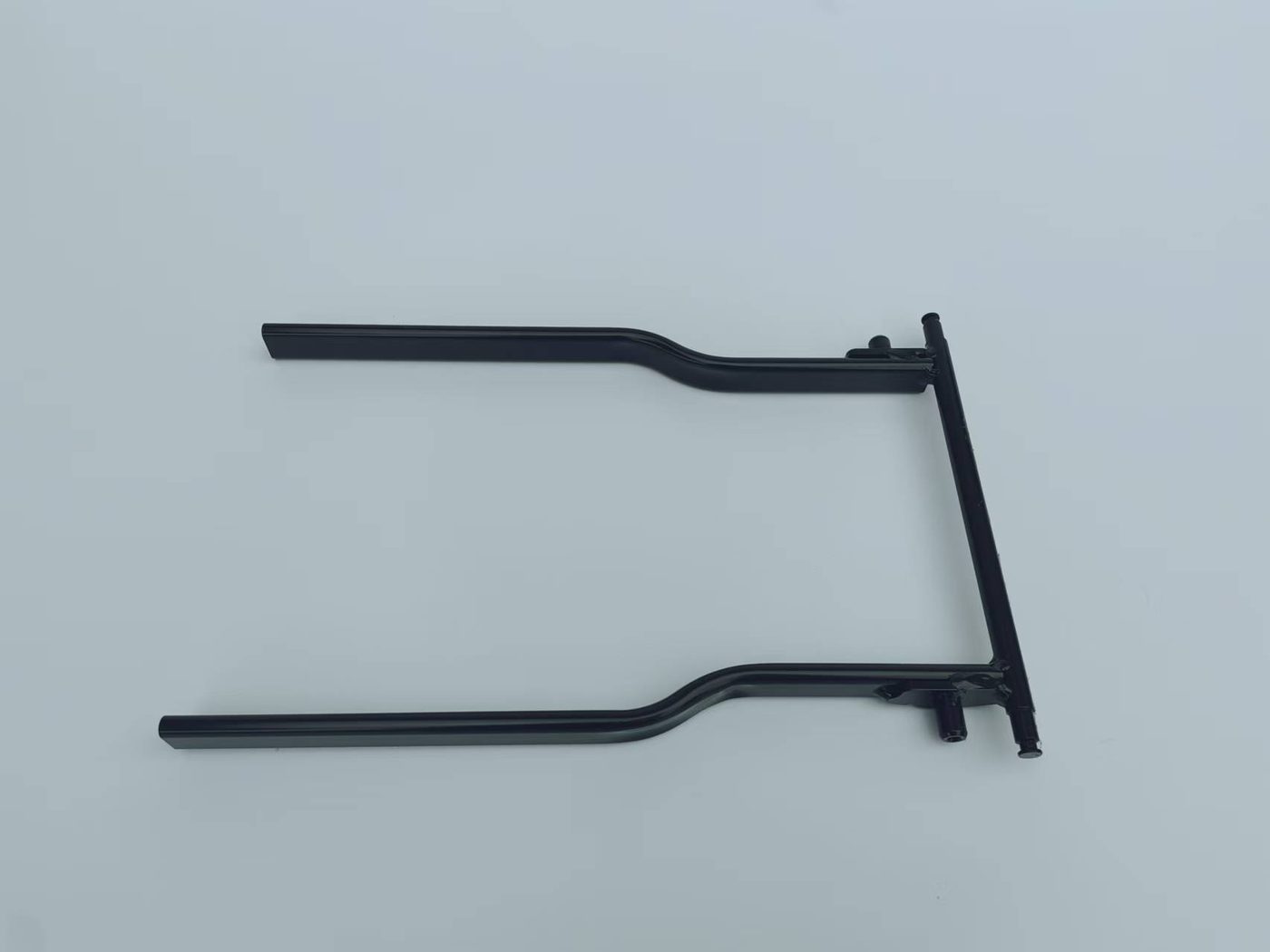
- Rear tubes and upright tubes — bent to profile, ends upset or formed as required.
- Cushion support tubes — spanning the seat width, carrying the cushion load.
- Necked-down tube assemblies — reduced-section ends for press-fit and swaged joints.
- Adjuster links — kinematic links for height and angle adjustment.
- Complete rear-seat cushion and back frames in which those tubes are welded together with wire and laser-cut brackets into one inspected assembly.
- Front-seat tube and wire parts — the tube parts that mount on a front-seat structure. To be explicit about the boundary: we do not build the front-seat structure itself, which is predominantly stamped sheet-metal panels and not a process we run.
We build to the seat maker's drawing and part number, and we do not publish our customers' part numbers or programme names anywhere on this site. Yours will not appear here either.
Capacity, and how much of it is free
| Family | Installed capacity | Actually run in 2025 | Spare |
|---|---|---|---|
| Tube parts | 8,000,000 pcs/year | 5,000,000 pcs | ≈35% |
| Wire-formed parts | 7,000,000 pcs/year | 4,000,000 pcs | ≈40% |
| Seat frames | 3,000,000 pcs/year | — | — |
| Hooks & accessories | 3,000,000 pcs/year | — | — |
We publish what we ran alongside what we installed, because an installed-capacity figure on its own tells you nothing about whether your programme would be displacing somebody else's. The gap is the answer to that question.
Lead times you can plan against
- Quotation: 3 working days from a drawing — either a three-line quotation or the specific list of what we still need to know.
- Wire-formed sample: 3 working days from a released drawing.
- Welded assembly, seat frame or tube part sample: 10 working days, which includes building the welding fixture needed to produce a sample that represents production rather than a hand-fitted one.
- Check fixtures and jigs: 3D printed in-house, so your validation loop is not waiting on hard tooling.
What to put on the drawing
The fields that decide whether we can quote or have to come back with questions: tube diameter, wall thickness and material specification; bend geometry as STEP if there is more than one bend plane; end conditions — upset, necked, cut profile; the datum scheme and which features are inspected restrained; weld locations with the weld specification and its acceptance criteria; the surface treatment requirement; and annual volume with your start-of-production date. Volume is the divisor in the tooling amortisation line, so without it the piece price is undefined rather than merely uncertain.
How it gets quoted
Three separate lines, never one number: part processing cost; tooling amortisation, with the divisor stated so you can recalculate it at a different volume; and outsourced surface treatment at the processor's rate. Each line can be challenged on its own. A single number cannot be.
Quality and what it is certified for
Our management system is certified to IATF 16949:2016, scope manufacture of seat frame assemblies, with design responsibility excluded — we manufacture to your drawing and do not hold product design authority. Chinese and English originals of the certificate go out with the quotation; we do not publish certificate identifiers on this site, and you can check current status yourself in the IATF Customer Portal from the certificate itself. For welded tube joints, our quality department issues weld penetration reports from sectioned and etched samples, part number by part number. Parts we built already ship to Mexico, Thailand and Malaysia — we name the countries, never the customers.
Questions about tube work
What tube diameters and wall conditions can you bend?
Our tube working equipment covers φ8 to φ52 mm tube: fully automatic laser tube cutting, multi-station CNC tube benders, necking presses and hydraulic presses. Wire forming is a separate line covering φ2 to φ14 mm wire on high-speed CNC benders with combined bend, flatten and pierce machines and upsetting heads. Achievable bend radius, ovality and wall thinning depend on the specific tube, wall thickness and material condition, so we read those off your drawing and tell you at quotation stage what we can hold rather than quoting a general figure here.
Can you weld the bent tube into a complete assembly?
Yes, and that is the normal case rather than an extra. Welding runs on 7 welding robots across the arc and spot lines, plus 20 TIG sets, 2 projection welders and 4 spot welders; the robots take the repeat-volume assemblies while the manual sets cover samples, low-volume variants and rework under the same weld specification. We supply bent tube on its own, tube welded into a sub-assembly, or a complete rear-seat cushion or back frame with the laser-cut brackets welded in, delivered inspected and ready to bolt in.
How much tube capacity do you have free?
Installed capacity on tube parts is 8 million pieces a year and we ran 5 million in 2025, so roughly 35 percent is spare. On wire-formed parts installed capacity is 7 million pieces a year against 4 million run in 2025, roughly 40 percent spare. We publish both the installed figure and what we actually ran because the gap between them, not the installed number on its own, is the room a new programme can move into without displacing an existing one.
How long does a tube part sample take?
A welded assembly, seat frame or tube part sample takes 10 working days from a released drawing, because that includes building the welding fixture needed to produce a sample that represents production rather than a hand-fitted one. A wire-formed part without welding takes 3 working days. Check fixtures and jigs are 3D printed in-house so your validation loop is not waiting on hard tooling.
Which steps of the tube process do you outsource?
One: surface treatment. E-coat and zinc plating are placed with qualified outside processors and passed through at the processor's rate as their own line in the quotation. Laser cutting of the tube, bending, necking, pressing, piercing, welding and final inspection all happen on our own floor. We state this before you ask, because the alternative is a buyer discovering it during a process audit.
Send the tube drawing
PDF, STEP, DWG or DXF, with annual volume and your start-of-production date. Within 3 working days you get back a three-line quotation or the precise list of what is still missing.